A2A vs MCP: Detailed Comparison
A2A vs MCP: Detailed Comparison
In agentic AI development, two key protocol types have emerged to improve interoperability: one connects agents to tools and resources, and the other enables agent-to-agent collaboration. The Agent2Agent (A2A) protocol and the Model Context Protocol (MCP) address distinct but highly complementary needs.
Model Context Protocol (MCP)
MCP defines how AI agents interact with and leverage individual tools and resources (such as databases or APIs).
It provides capabilities such as:
- Standardizing how AI models and agents connect to and interact with tools, APIs, and other external resources
- Defining a structured way to describe tool capabilities (similar to function calling)
- Passing inputs to tools and receiving structured outputs
- Supporting common use cases like calling external APIs, querying databases, or invoking predefined functions
Agent2Agent Protocol (A2A)
A2A focuses on enabling different agents to collaborate to achieve shared goals.
It provides capabilities such as:
- Standardizing how independent, often opaque agents communicate and collaborate as peers
- Providing an application-layer protocol for agents to discover each other, negotiate interactions, manage shared tasks, and exchange conversational context and complex data
- Supporting use cases like a customer support agent delegating to a billing agent, or a travel agent coordinating with flight/hotel/activity agents
Why do we need different protocols?
MCP and A2A are both necessary to build complex AI systems because they solve different but complementary problems. The difference largely comes down to what an agent is interacting with.
Tools and resources (MCP domain):
- Characteristics: Typically primitives with well-defined structured inputs/outputs. They perform specific, often stateless functions (e.g., calculators, database query APIs, weather services).
- Purpose: Agents use tools to gather information and perform discrete actions.
Agents (A2A domain):
- Characteristics: More autonomous systems that reason, plan, use multiple tools, maintain state over longer interactions, and engage in complex multi-turn dialogue to accomplish evolving tasks.
- Purpose: Agents collaborate with other agents to handle broader, more complex goals.
A2A ❤️ MCP: Complementary protocols in agent systems
An agent application may primarily use A2A to communicate with other agents, while each individual agent uses MCP internally to interact with its own tools and resources.
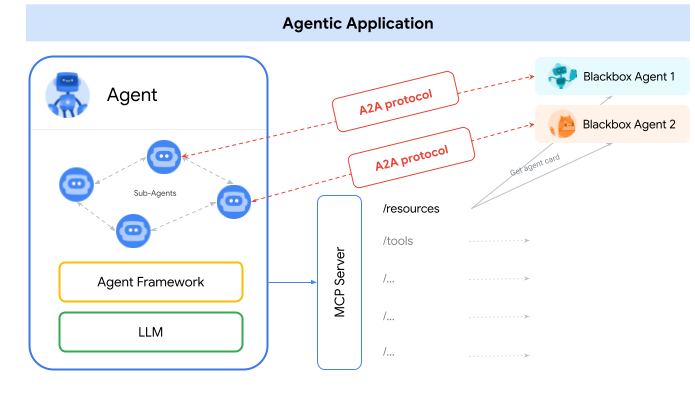
An agent application may use A2A to collaborate with other agents, while each agent uses MCP internally to access its tools and resources.
Example scenario: an auto repair shop
Consider an auto repair shop staffed by autonomous AI “mechanic” agents. These mechanics use specialized tools such as diagnostic scanners, repair manuals, and vehicle lifts to diagnose and fix problems. The repair process may involve extended dialogue, research, and coordination with parts suppliers.
Customer interaction (user → agent via A2A): The customer (or their primary assistant agent) communicates with the “shop manager” agent via A2A.
For example: “My car is making a clicking noise.”
Multi-turn diagnostic dialogue (agent ↔ agent via A2A): The shop manager conducts a multi-turn diagnostic dialogue via A2A.
For example: “Can you send a video of the noise?” or “I see a fluid leak—how long has this been happening?”
Internal tool use (agent → tools via MCP): A mechanic agent uses MCP to interact with tools needed for diagnosis.
For example:
- An MCP call to a “vehicle diagnostic scanner” tool:
scan_vehicle_for_error_codes(vehicle_id='XYZ123') - An MCP call to a “repair manual database” tool:
get_repair_procedure(error_code='P0300', vehicle_make='Toyota', vehicle_model='Camry') - An MCP call to a “vehicle lift” tool:
raise_platform(height_meters=2)
- An MCP call to a “vehicle diagnostic scanner” tool:
Delegation and coordination (agent ↔ agent via A2A): A mechanic agent may coordinate with other specialist agents.
For example, the mechanic uses A2A to talk to a “parts procurement” agent: “I need to order an ignition coil for a 2019 Toyota Camry. The customer budget is $500.”
Key differences summary
| Aspect | A2A Protocol | MCP |
|---|---|---|
| Primary purpose | Agent collaboration | Agent–tool integration |
| Interacts with | Autonomous agents | Tools and resources |
| Complexity | Multi-turn dialogue, state management | Single function calls |
| Statefulness | Stateful interactions | Usually stateless |
| Autonomy | Highly autonomous participants | Passive tool execution |
| Negotiation | Supports negotiation and clarification | Structured input/output |
| Example use cases | Support agent delegates to an expert | DB queries, API calls |
Best practices
When to use A2A
- You need multiple agents to collaborate on complex tasks
- The interaction involves multi-turn dialogue and negotiation
- Participants have autonomous decision-making
- You need delegation and result aggregation
When to use MCP
- An agent needs access to external tools or data
- You’re executing structured, predefined operations
- You’re integrating with APIs, databases, or specialized services
- You need a standardized tool calling interface
Using both together
In complex AI systems, the two protocols are often used together:
- External collaboration: Use A2A for high-level agent-to-agent coordination
- Internal tool access: Use MCP within each agent to access the tools it needs
- Layered architecture: A2A at the coordination layer; MCP at the execution layer
Tip: Understanding the differences (and complementarities) between A2A and MCP is key to designing effective agent systems. Choosing the right protocol can significantly improve maintainability and scalability.